Competitive Landscape
Market context, competitor framing, and differentiation logic supporting the current launch strategy.
Competitive Landscape
Competitor Analysis
- Brand: Thoughtseed
- Analysis Date: 2026-04-24
- Market Category: Founder-led systems studio / premium product systems / coherent brand-and-system execution
Competitors
Item 1
- Name: Large innovation consultancies
- Category: Strategy and transformation consulting
- Positioning: Broad strategic capability and enterprise signaling.
Strengths
- Strong process packaging
- Enterprise credibility
- Large teams and procurement comfort
Weaknesses
- Often too heavy for fast founder-led work
- Strategy-to-build handoff can be fragmented
- Aesthetic and narrative output can feel generic
- Summary: They win on scale and procurement comfort, but often lose on intimacy, velocity, and coherence from concept to shipped product.
Item 2
- Name: Premium product design agencies
- Category: Brand, web, and product design
- Positioning: Tasteful digital execution and polished public-facing work.
Strengths
- High craft in interface and web surfaces
- Strong presentation quality
- Premium visual positioning
Weaknesses
- May stop at design handoff instead of delivery ownership
- Can over-index on aesthetics relative to systems architecture
- Often weaker in IoT, AI integration, or operational tooling
- Summary: They are strong reference points for polish, but not always for cross-disciplinary delivery depth.
Item 3
- Name: AI integration consultancies
- Category: Automation and AI implementation
- Positioning: Fast AI enablement and workflow modernization.
Strengths
- Technical momentum
- Current tooling fluency
- Clear efficiency narrative
Weaknesses
- Brand and product experience are often underdeveloped
- Tendency toward wrapper logic instead of durable systems thinking
- Visual and narrative surfaces often feel interchangeable
- Summary: They can move quickly on tooling, but frequently lack the narrative and experiential layer that makes adoption durable.
Item 4
- Name: Specialized engineering vendors
- Category: Software or IoT implementation
- Positioning: Execution-first technical delivery.
Strengths
- Depth in a narrow technical domain
- Implementation discipline
- Clear scope execution
Weaknesses
- Limited strategic or brand framing
- Weak alignment between user story and system behavior
- Public-facing outputs often require another partner
- Summary: Useful when the problem is purely technical, weaker when the product needs narrative, positioning, and experience design at the same time.
Item 5
- Name: Independent freelancer swarms
- Category: Flexible creative and technical talent pools
- Positioning: Cost-flexible, fast to assemble, specialized.
Strengths
- Low overhead
- Flexible staffing
- Potentially strong specialists
Weaknesses
- High coordination burden on the client
- Inconsistent accountability
- System coherence depends on founder time
- Summary: They can be efficient on paper, but the client often becomes the integrator.
Indirect Competitors
Item 1
- Name: In-house product teams
- Category: Internal capability
- Weakness Vs Us: Strong internal context, but often overstretched or missing external perspective and specialized execution depth.
Item 2
- Name: No-code and template stacks
- Category: Tool-led delivery
- Weakness Vs Us: Good for speed, weak for original brand systems, complex behavior, or deeper product architecture.
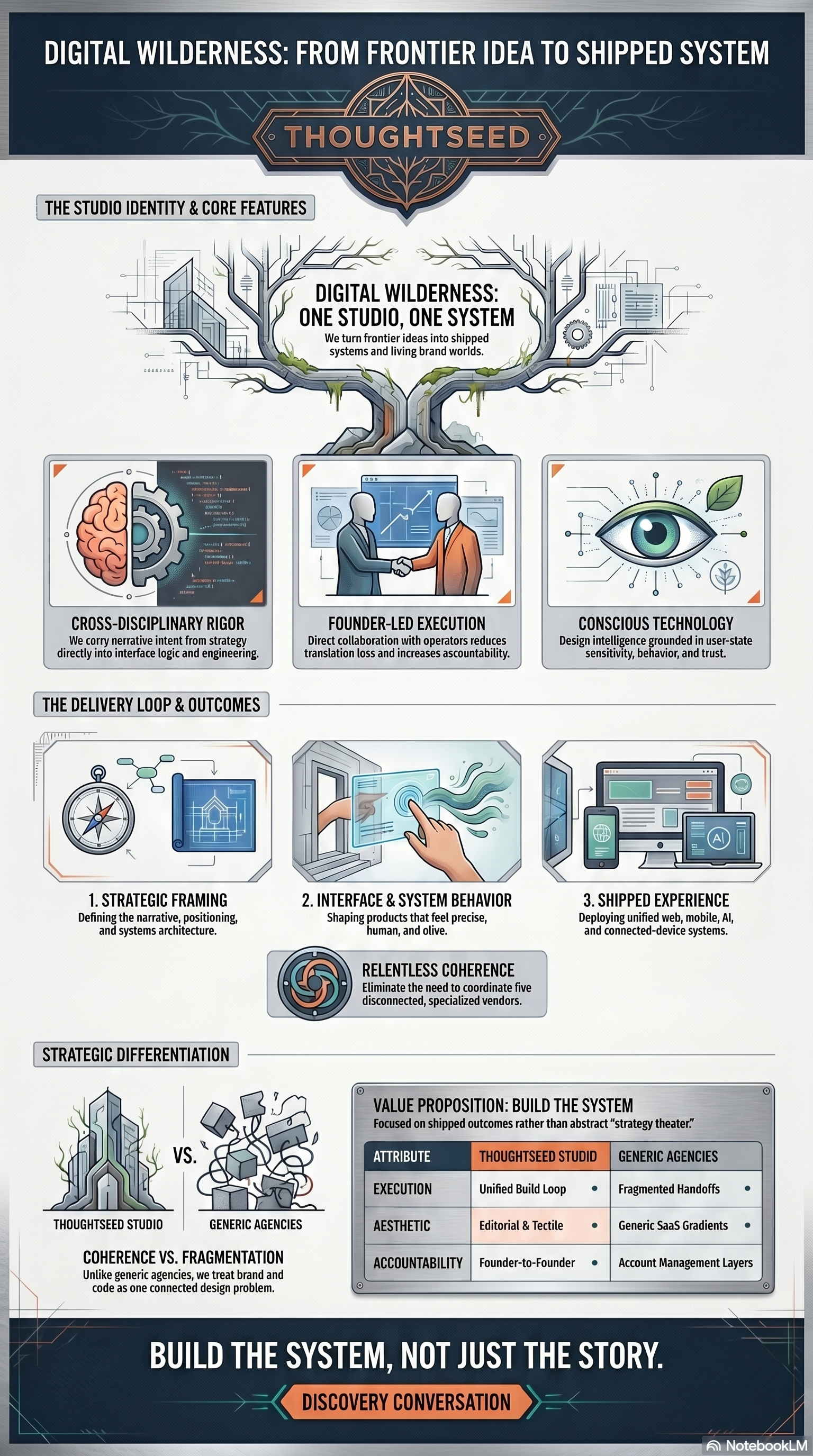
- Key Differentiators: Thoughtseed combines brand strategy, product systems, engineering delivery, AI integration, and a distinctive point of view on user state and product coherence inside one founder-led execution loop.
Thoughtseed Differentiators
Item 1
- Differentiator: Cross-disciplinary rigor
- Why It Wins: Thoughtseed can move from story, positioning, and interface logic into buildable system decisions without a major handoff.
Item 2
- Differentiator: Founder-led execution
- Why It Wins: Decision-makers interact closer to the operators shaping the work, which reduces translation loss and increases accountability.
Item 3
- Differentiator: User-state-aware product design
- Why It Wins: The studio considers user state, meaning, and behavior as part of product design while still staying grounded in real engineering work.
Item 4
- Differentiator: Studio plus IP portfolio
- Why It Wins: Thoughtseed is not only a service vendor; it also develops reusable products and experiments, which sharpens its product judgment.
Market Gaps Exploited
- Studios that can own both narrative and system delivery without collapsing into generic consulting.
- Teams that want AI and automation integrated into product logic rather than bolted on as a demo layer.
- Clients seeking premium visual and verbal identity without losing technical seriousness.
- Decision-makers who need fewer vendors and clearer accountability.
Visual Differentiation Strategy
Avoid
- purple-on-white generic SaaS gradients
- empty futurism
- stock innovation photography
- agency-polished but personality-free layouts
- wellness cliches dressed up as tech
Own
- editorial precision with atmospheric depth
- signal-rich systems language
- tactile materials and intentional typography
- a digital wilderness feel that is calm, crafted, and technically grounded
Competitive Advantages
- Public Service Mix: Thoughtseed already presents Brand Strategy, Growth Marketing, Web Development, UI/UX Design, Mobile Apps, and AI Integration as one public system.
- Operating Model: The vault documents a live client-delivery engine, a reusable product/IP layer, and a research-to-product lab.
- Technical Range: Thoughtseed has documented experience across IoT, biofeedback, Web3, AI, and digital product systems.
- Brand Memory: Digital Wilderness and the studio tagline create a memorable territory beyond generic service positioning.
Strategic Recommendations
- Lead with coherence: one studio, one delivery loop, multiple disciplines.
- Show shipped outcomes and working systems early in the narrative.
- Keep user-state language grounded in design and product intelligence.
- Use the visual system to signal maturity and intent, not trendiness.
- Position Thoughtseed as a serious partner for frontier work that still has to get built.