Study Guide
This study guide provides a detailed synthesis of Thoughtseed’s brand identity, market positioning, and operational philosophy. It is designed to fac…
Thoughtseed: A Comprehensive Study Guide to the Coherent Systems Studio
This study guide provides a detailed synthesis of Thoughtseed’s brand identity, market positioning, and operational philosophy. It is designed to fac…
Imported Report
This study guide provides a detailed synthesis of Thoughtseed’s brand identity, market positioning, and operational philosophy. It is designed to facilitate a deep understanding of how the studio unifies brand, product, and engineering under the “Digital Wilderness” theme.
I. Core Brand Identity and Philosophy
The Thoughtseed Mission
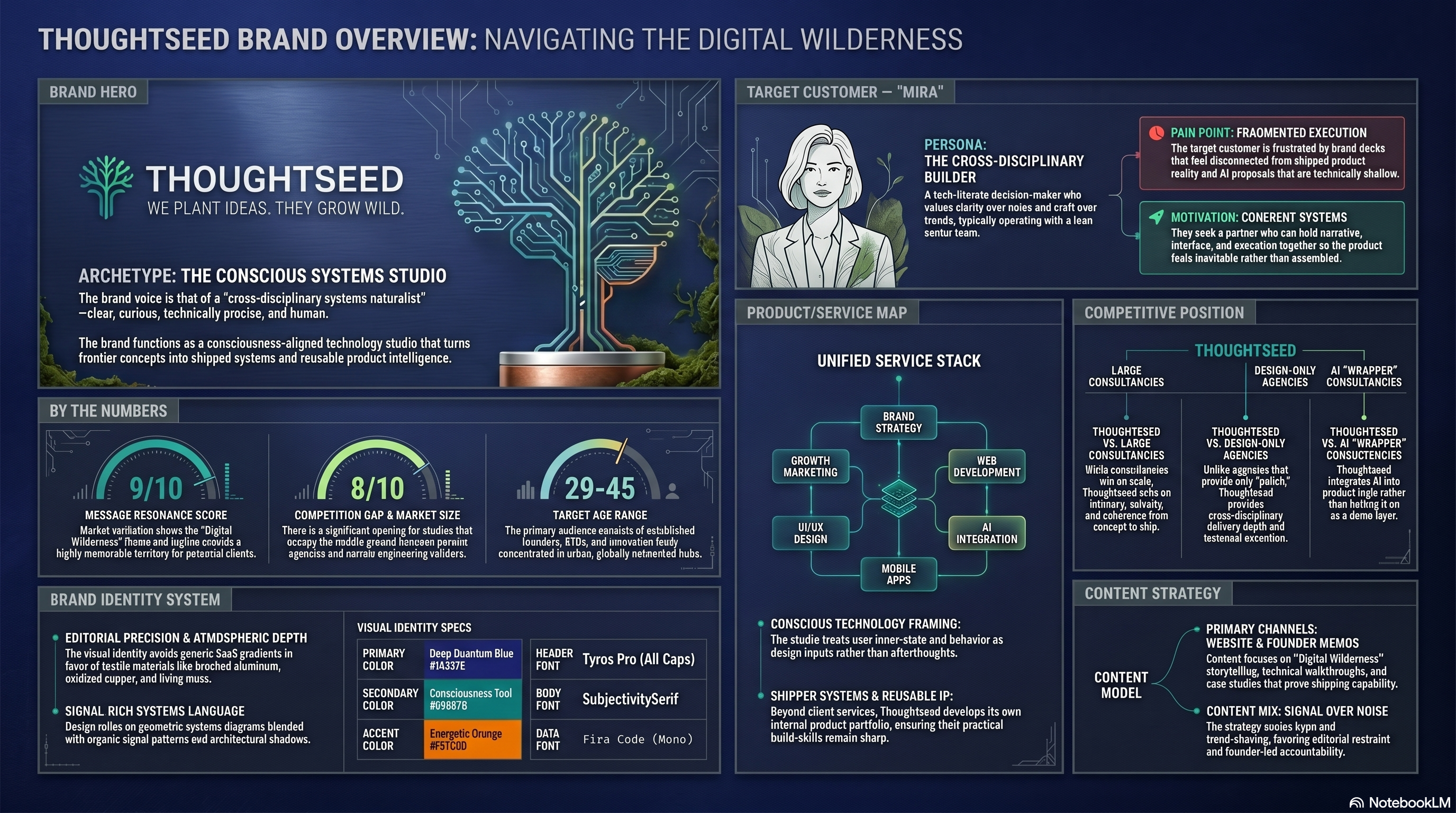
Thoughtseed is a founder-led systems studio based in Bengaluru. Its primary mission is to turn frontier ideas into shipped systems, living brand worlds, and reusable product intelligence. The studio operates at the intersection of science, engineering, design, and art, treating meaning, behavior, and system architecture as a single connected problem.
The “Digital Wilderness” Theme
The central metaphor for Thoughtseed is the Digital Wilderness, described as a living brand system where precise engineering and organic emergence cross-pollinate. It is envisioned as a cultivated signal garden where diverse disciplines grow into final product forms.
Brand Core Essentials
- Tagline: “We plant ideas. They grow wild.”
- Archetype: The Coherent Systems Studio.
- Voice Persona: The cross-disciplinary systems naturalist.
- Core Message: Helping frontier teams turn ideas into coherent systems by unifying brand, product, engineering, and experimentation.
- Call to Action (CTA): “Build the system, not just the story.”
II. Key Strategic Pillars
The studio’s operations and value proposition are built upon four fundamental pillars:
- Cross-Disciplinary Rigor: Moving seamlessly from story and positioning into buildable system decisions without handoff friction.
- User-State-Aware Technology: Grounding technology in user state, meaning, and behavior. This is framed as design intelligence rather than spiritual or wellness abstraction.
- Shipped Systems over Strategy Theater: Prioritizing concrete outcomes and working systems over pure advisory models or moodboards.
- Founder-Led Experimentation: Direct interaction between decision-makers and operators to reduce translation loss and increase accountability.
III. Market Dynamics and Audience
The Target Persona: “The System-Carrying Founder” (Mira)
- Demographics: Aged 29–45; located in globally networked urban centers (India, Europe, North America).
- Role: Founders, CTOs, or innovation leads with high technical comfort.
- Key Pain Point: Fragmented execution caused by managing multiple disconnected vendors (e.g., separate brand, design, and engineering shops).
- Aspiration: Building systems that users trust because they feel coherent at every layer.
Competitive Landscape
Thoughtseed differentiates itself from several market categories:
- Innovation Consultancies: Thoughtseed wins on intimacy and velocity compared to large-scale consultancies.
- Design Agencies: Thoughtseed offers deeper cross-disciplinary delivery beyond surface polish.
- AI Consultancies: Thoughtseed integrates AI into product logic rather than bolting it on as a “demo layer.”
- Engineering Vendors: Thoughtseed provides the narrative and experience design that purely technical vendors often lack.
IV. Visual and Sensorial Identity
Color Palette
| Name | Hex Code | Role |
|---|---|---|
| Deep Quantum Blue | #1A237E | Backgrounds, anchor surfaces, long-horizon trust. |
| Signal Teal | #00897B | Primary accent, directional signal, interface energy. |
| Energetic Orange | #F57C00 | Calls to action, ignition, emphasis. |
| Mindful Gray | #37474F | Metadata, borders, secondary text. |
| Growth Light | #B8E986 | Alive moments, positive movement, emergent insight. |
Typography and Materials
- Header: Tyros Pro (all caps, light display weight).
- Body: SubjectivitySerif (warm editorial voice).
- Data: Fira Code (technical labels and diagrams).
- Tactile Materials: Matte paper, glass, brushed aluminum, oxidized copper, weathered stone, and living moss.
V. Short-Answer Practice Questions
- Where is Thoughtseed located?
- Answer: Bengaluru, India.
- What is the core problem Thoughtseed aims to solve for founders?
- Answer: Fragmented execution where frontier ideas are split across disconnected brand, product, and engineering vendors.
- Identify the primary typeface used for Thoughtseed headers.
- Answer: Tyros Pro.
- What does “User-State-Aware Technology” mean in the context of Thoughtseed’s design philosophy?
- Answer: It means design intelligence and user-state sensitivity grounded in shipped systems, rather than vague spiritualism.
- What are the two components of the “Digital Wilderness” duality?
- Answer: Precise engineering and organic emergence.
- Who is the “Internal Name” for the target buyer persona?
- Answer: Mira.
- Which brand colors are used for “ignition” and “calls to action”?
- Answer: Energetic Orange (#F57C00).
VI. Essay Prompts for Deeper Exploration
- The Coherence Argument: Analyze why Thoughtseed prioritizes a “single delivery loop” over the traditional multi-vendor model. Discuss how this approach reduces “translation loss” for a founder like Mira.
- Visual Differentiation in Tech: Thoughtseed explicitly avoids “purple-on-white generic SaaS gradients” and “stock innovation photography.” Evaluate how their chosen palette (Deep Quantum Blue and the teal signal accent #00897B) and materials (living moss, oxidized copper) contribute to the “Digital Wilderness” aesthetic.
- The Role of IP in a Service Studio: Thoughtseed is described as both a service vendor and a developer of reusable product IP. Discuss how having a “research-to-product lab” sharpens a studio’s capability to deliver for external clients.
- User State vs. Wellness: Differentiate between “user-state-aware technology” as defined by Thoughtseed and “wellness cliches.” How does the studio use “technical precision” in its voice to avoid sounding like a spiritual brand?
VII. Glossary of Important Terms
- CBBE (Customer-Based Brand Equity): The framework used to analyze Thoughtseed’s brand salience, performance, and resonance.
- User-State-Aware: A design approach that considers the user’s inner state, trust, and behavior as primary design inputs.
- Cross-Disciplinary Rigor: The ability to maintain intent and quality across different fields, such as moving from brand strategy to software engineering without losing coherence.
- Digital Wilderness: The signature visual and philosophical territory of Thoughtseed; a blend of the technical and the organic.
- Frontier Ideas: High-complexity concepts involving emerging technologies like AI, IoT, biofeedback, or Web3.
- Points of Difference (PODs): Features that make Thoughtseed unique, including its founder-led judgment and integrated studio logic.
- Points of Parity (POPs): Standard services Thoughtseed provides that match market expectations, such as UI/UX design and mobile development.
- Signal-Rich: A visual style that uses data-driven elements, precise linework, and systems language to convey depth and intelligence.
- Systems Naturalist: The brand’s specific tone, characterized by being clear, curious, and technically precise while remaining human.
- The Vault: The internal documentation of Thoughtseed’s client-delivery engine, reusable products, and operating model.